
After choosing the variant, the gearbox is the biggest single decision on an Indian car’s price list. An automatic usually adds somewhere between ₹55,000 and ₹1.35 lakh to the ex-showroom price, and the showroom rarely spells out what, beyond not having to work a clutch, that money actually buys.
To answer it with numbers rather than opinions, we compared the manual and automatic versions of the same car, the same variant, the same engine and the same fuel, so that the price difference is the gearbox and nothing else. That gives 327 pairs across 68 cars, all at Delhi ex-showroom prices checked in October 2026. The per-car figures behind this article are in CarMaths’ guide to what each automatic costs.
The four kinds of automatic, in plain words
- AMT (automated manual). A normal manual gearbox with a motor working the clutch and the gear lever for you. It is the cheapest to make and the cheapest to buy, and it is the one that pauses between gears. Maruti calls its version AGS.
- CVT (continuously variable transmission). No fixed gears at all: a belt runs between two cones and keeps the engine at its best speed. It is very smooth, though the engine note does not rise and fall the way most drivers expect. Hyundai and Kia call theirs IVT.
- Dual-clutch (DCT). Two clutches, one holding the next gear ready, so a gear change is a quick hand-over rather than a pause. It is mostly paired with turbo-petrol engines. Tata calls it DCA, and Skoda and Volkswagen call it DSG.
- Torque converter. The traditional automatic, with a fluid coupling instead of a clutch and a set of fixed gears it changes for you.
A clutchless manual (iMT) is not an automatic, because you still choose every gear, so it is left out of the figures below.
What each kind costs over the manual
| Gearbox | Typical extra price | Range | Pairs (cars) |
| AMT | ₹55,000 | ₹35,000 to ₹87,000 | 113 (24) |
| CVT | ₹1,20,500 | ₹60,500 to ₹1,50,000 | 38 (12) |
| Dual-clutch (DCT) | ₹1,30,000 | ₹1,01,500 to ₹2,03,000 | 28 (11) |
| Torque converter | ₹1,35,000 | ₹71,000 to ₹4,20,000 | 148 (36) |
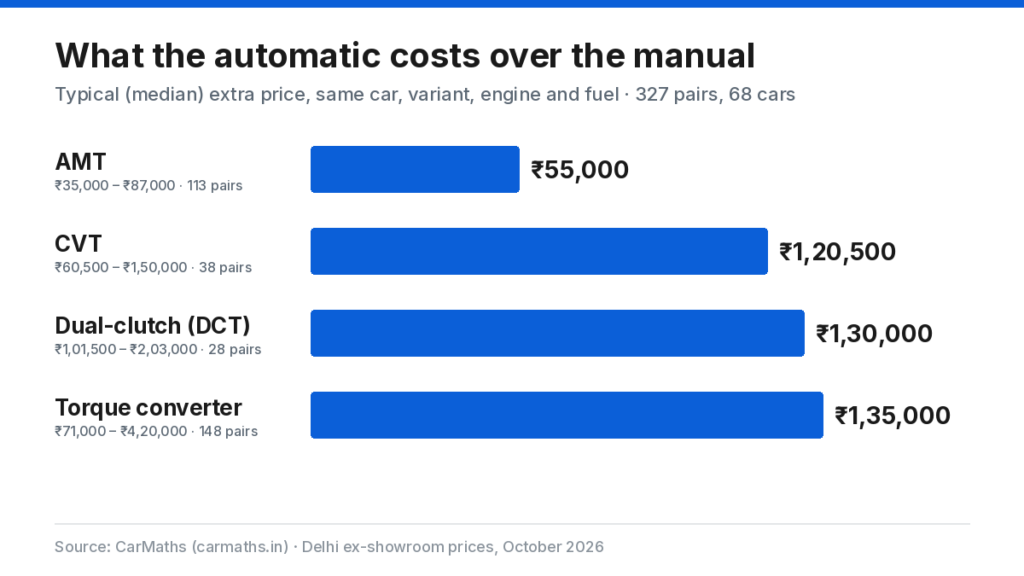
The AMT sits in a tight band: no AMT pair costs more than ₹87,000 over its manual. The torque converter has by far the widest range, from ₹71,000 on the Kia Sonet HTE(O) to ₹4,20,000 on the Jeep Meridian Longitude diesel, because it is fitted to everything from compact SUVs to large seven-seaters.
One car shows the gap between the kinds on a single variant. The Tata Nexon Creative with the 1.2 turbo petrol is sold with both an AMT and a DCA. The AMT costs ₹70,000 more than the manual; the DCA costs ₹1,25,000 more.
Seven cars cannot be compared this way at all: the Kia Seltos, Kia Sonet, Hyundai Creta, Skoda Slavia, Skoda Kushaq, Volkswagen Virtus and Volkswagen Taigun sell their dual-clutch gearbox only with an engine that has no manual version. On those cars, choosing the automatic also means choosing a different engine.
The cheapest way into each kind
| Gearbox | Cheapest automatic | Price | Its manual twin |
| AMT | Maruti S-Presso VXi(O) AGS | ₹4,77,400 | ₹4,32,400 |
| CVT | Honda Amaze V CVT | ₹8,70,400 | ₹7,65,400 |
| Torque converter | Skoda Kylaq Classic+ AT | ₹9,29,000 | ₹8,29,000 |
| Dual-clutch (DCT) | Tata Altroz Creative S DCA | ₹9,64,990 | ₹8,44,990 |
If the budget is under ₹5 lakh, an AMT is the only automatic on offer. A CVT, a torque converter or a dual-clutch starts close to ₹9 lakh.
What the extra money buys besides convenience
On many cars the automatic is not just a different gearbox. Makers often fit extra equipment to the automatic version only, so part of the premium pays for features.
Of the 327 pairs, the automatic carries equipment the manual does not have in 202. In 125 it adds nothing that we track.
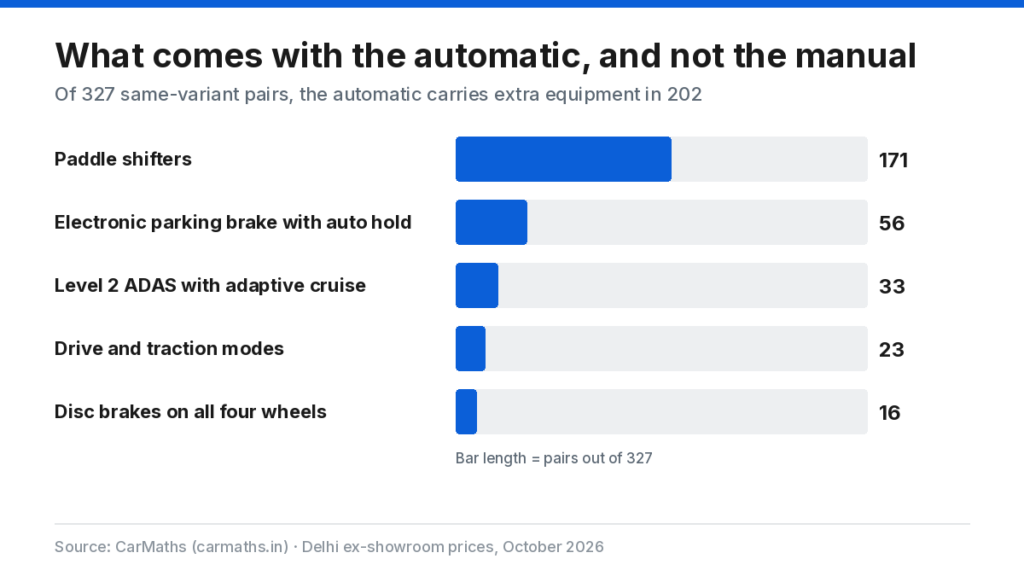
Paddle shifters are the most common addition, on 171 pairs, and on their own they are worth little. The additions that matter are rarer: an electronic parking brake with auto hold on 56 pairs across 17 cars, and Level 2 ADAS with adaptive cruise control on 33 pairs across 12 cars, including the Mahindra XUV 7XO, Tata Harrier and Hyundai Verna, where the manual of the same variant gets no ADAS at all.
The Kia Seltos HTK(O) petrol is a good example. The IVT costs ₹1,30,000 more than the manual (₹15,81,900 against ₹14,51,900) and also adds ventilated front seats, a powered driver’s seat, drive and traction modes, paddle shifters and the electronic parking brake. On that variant, a real share of the premium is equipment rather than gearbox. Where the automatic does add equipment, the typical value of what it adds is about ₹12,500 at the rupee values CarMaths gives each feature, well below what the automatic costs. So for most buyers the premium is still mainly paying for the gearbox
Does the automatic cost more to run?
Comparing the certified fuel-efficiency figures of each pair, petrol, diesel and CNG alike, where the maker publishes both:
- AMT: more efficient than the manual in 45 of 54 pairs. The Maruti Swift VXi is certified at 25.35 km/l as a manual and 26.25 km/l as an AMT.
- CVT: more efficient in 19 of 25 pairs. The Hyundai Creta S(O) petrol goes from 17.4 to 17.7 km/l with the IVT.
- Dual-clutch: more efficient in 4 of 6 pairs.
- Torque converter: less efficient in all 54 pairs. The Skoda Kylaq Classic+ drops from 19.68 km/l as a manual to 19.05 km/l as an automatic.
These are laboratory figures, and real-world economy depends on how and where you drive. But the pattern is clear. An AMT or a CVT usually costs nothing extra to run and can be slightly cheaper. A torque converter usually costs a little more.
The gap grows on the road
Road tax and insurance are charged as a share of the car’s price, so the automatic’s premium gets bigger once the car is registered.
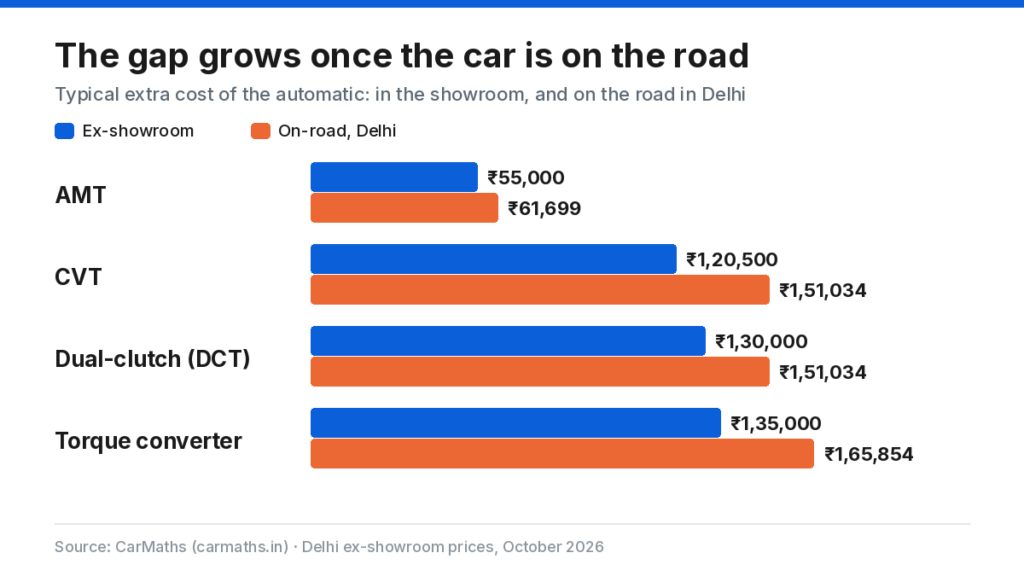
| Gearbox | Typical gap, ex-showroom | Typical gap, on-road in Delhi | Highest state |
| AMT | ₹55,000 | ₹61,699 | ₹66,396 (Karnataka) |
| CVT | ₹1,20,500 | ₹1,51,034 | ₹1,62,565 (Karnataka) |
| Dual-clutch (DCT) | ₹1,30,000 | ₹1,51,034 | ₹1,62,565 (Karnataka) |
| Torque converter | ₹1,35,000 | ₹1,65,854 | ₹1,82,982 (Kerala) |
Each typical figure is the middle of its own list, so the CVT and dual-clutch land on the same on-road gap: in both, the middle pair is a ₹1,30,000 automatic on a car over ₹10 lakh.
Two worked examples. The Maruti Swift VXi AMT costs ₹45,000 more than the manual in the showroom, which becomes ₹50,481 on the road in Delhi and ₹54,324 in Karnataka. The Hyundai Creta S(O) petrol IVT costs ₹1,45,000 more than its manual, which becomes ₹1,68,461 in Delhi and ₹1,81,323 in Karnataka.
Which buyer each kind suits
- AMT suits a tight budget and mostly city driving. It is the cheapest automatic by a wide margin and usually the most efficient, and you live with a pause between gears.
- CVT suits buyers who want smooth driving in traffic and on the highway, with efficiency close to or better than the manual.
- Dual-clutch suits keen drivers who want quick gear changes. It is usually paired with a turbo engine and costs well over ₹1 lakh more.
- Torque converter suits buyers who value smoothness and durability, especially in bigger cars. It costs the most and is slightly less efficient.
When the manual is still the better buy
- When the automatic premium is close to the price of the next variant up, and that variant has equipment you would use every day.
- When the automatic is a torque converter on a smaller car and most of your driving is on open roads, where it costs more to buy and more to run.
- When the automatic is only sold with a different engine. Then you are paying for the engine as well as the gearbox, and the comparison is no longer like for like.
A short checklist before you sign
- Test-drive the exact gearbox you are paying for. An AMT and a dual-clutch on the same car feel very different.
- Compare on-road prices, not ex-showroom. The gap grows with road tax and insurance.
- Check what equipment comes with the automatic variant. Sometimes the automatic carries features that the manual of the same variant does not.
- Check that the manual and automatic you are comparing have the same engine.
The automatic is worth paying for when you will use it every day, and an AMT makes that possible for the least money. Before you book, confirm the current price on the manufacturer’s own site. Maruti’s official S-Presso page, for example, is the place to check the cheapest automatic in our data.