
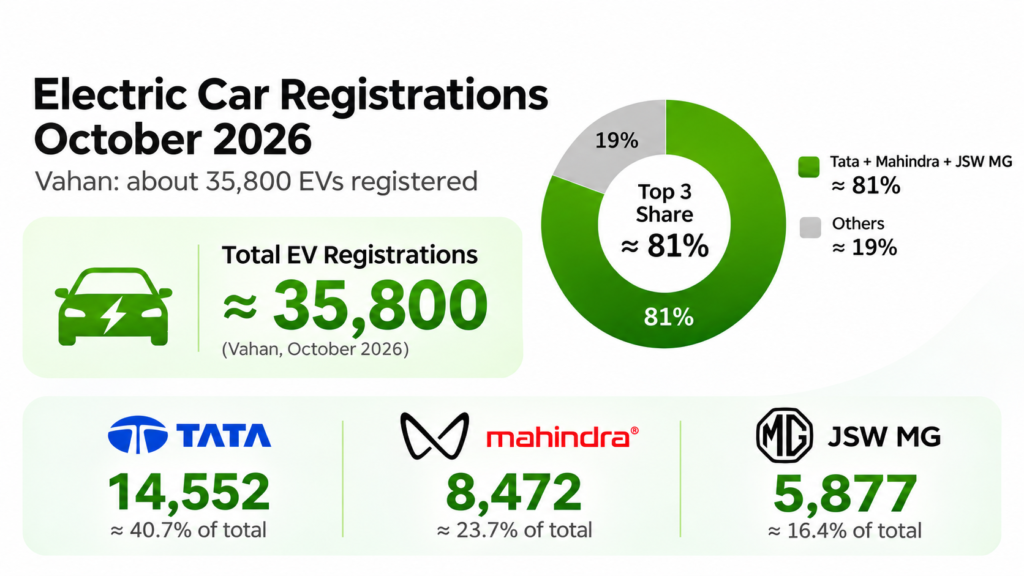
October 2026 delivered a landmark reading for the Indian electric mobility market. India electric car registrations October 2026 crossed 36,000 units for the first time in Vahan history, with the Ministry of Road Transport and Highways’ Vahan portal recording approximately 36,064 passenger battery electric vehicles across all states. The month’s total reflects the annual festive season delivery surge — Navratri and Dussehra fell in the first half of October — and builds on a 2026 that has consistently set new EV registration records. This article covers the full brand-by-brand breakdown, market share movements, model-level rankings, state-level concentration, and what the October data reveals about India’s EV transition heading into Q4 2026.
India EV Market Context — October 2026 in the Bigger Picture
The Indian electric mobility market entered October 2026 on the back of eight consecutive months of year-on-year growth. Through September 2026, cumulative passenger electric vehicle registrations in India had already surpassed the full-year 2025 total — a reflection of new model launches from Mahindra, Tata, Hyundai, and VinFast throughout the first three quarters of the year.
Electric vehicle market penetration in India’s total passenger vehicle registrations ran at approximately 7.3% through the October month itself, up sharply from 3.6% in October 2025. The October 2026 automotive calendar carried a structural advantage: festive season deliveries, booked during Navratri and Dussehra promotions, converted to Vahan registrations in the first three weeks of October, inflating the monthly count relative to surrounding months.
All figures in this article draw from Vahan registration data as published on the Ministry of Road Transport and Highways’ portal and third-party analyses from AutoPunditz and Autocar Pro. Figures are subject to revision as late registrations are added to the Vahan system.
Why October Registration Figures Differ from Retail Sales Numbers
Retail sale occurs when a dealer raises an invoice to the customer and transfers the vehicle. Vahan registration happens when the buyer completes RTO registration — a step that often follows the invoice date by several days to several weeks. Some vehicles invoiced in September register in October, and vehicles invoiced in October may carry November registration dates. This lag means month-on-month registrations from Vahan and OEM-issued wholesale dispatch press releases will not match exactly for the same calendar month.
Total India Electric Car Registrations October 2026 — The Headline Numbers
India electric car registrations October 2026 reached approximately 36,064 passenger battery electric vehicles (BEV), based on Vahan registration data as reported by AutoPunditz. A second data source, JATO Dynamics, reported 36,646 units for the same period — the minor variance reflects different snapshot timestamps from the Vahan portal and different counting methodologies. For consistency, this article uses the AutoPunditz Vahan-sourced figure of 36,064 as the primary reference.
Year-on-year, India EV registration statistics October 2026 show a 76.7% increase over October 2025’s 20,411 units — meaning India registered approximately 15,653 more passenger electric cars in October 2026 than in the same month a year earlier. This is the strongest year-on-year growth the Indian passenger EV segment has recorded in any October period.
Month-on-month, the October figure was modestly lower than September 2026’s 37,336 units — a decline of approximately 3.4%. The festive delivery surge that lifted September’s record was partly pulled forward from October, making the October-versus-September comparison less informative than the year-on-year figure. Electric passenger vehicle sales India October 2026 as a share of total passenger vehicle registrations stood at 7.3%, doubling the 3.6% penetration recorded in October 2025.
The five states that consistently dominate month-on-month registrations in India’s EV data — Maharashtra, Karnataka, Delhi, Gujarat, and Tamil Nadu — maintained their positions in October 2026, collectively accounting for the majority of the month’s total battery electric vehicles (BEV) registered. Maharashtra and Karnataka continued to post the highest EV penetration rates within their total passenger vehicle registration bases, supported by ongoing road tax exemption policies.
Top Selling Electric Car Brands in India October 2026 — Brand-by-Brand Breakdown
Top selling electric car brands in India October 2026 showed a market led by Tata Motors, Mahindra, and JSW MG Motor India — in that order for the seventh consecutive month in 2026. Tata Mahindra MG electric car sales October 2026 together accounted for approximately 80.9% of all passenger electric vehicle registrations in India during the month. EV manufacturer market share moved materially for two brands — VinFast surged and MG declined — against an otherwise stable top-three structure.
Tata Motors Electric Vehicles — October 2026 Performance
Tata Motors electric vehicles registered 14,669 units in October 2026, capturing a 40.7% EV market share — broadly unchanged from September’s 40.5%. Year-on-year growth stood at 77.6% over October 2025’s 8,282 units. The Punch EV remained Tata’s highest-volume model, consistent with its position as the segment’s best seller through most of 2026. The Nexon EV, Tiago EV, Curvv EV, Harrier EV, and Sierra EV rounded out the Tata portfolio — a six-model EV lineup that gives Tata breadth across the Rs 8–28 lakh price range. For Tata Mahindra MG electric car sales October 2026, Tata’s volume leadership is structural rather than cyclical.
Mahindra Electric SUVs — October 2026 Performance
Mahindra electric SUVs registered 8,542 units in October 2026, claiming a 23.7% EV market share and posting 85.7% year-on-year growth over October 2025’s 4,599 units. Mahindra gained 1.2 percentage points of market share month-on-month, the strongest brand-level gain among the top three. The BE 6 and XEV 9e were the primary volume drivers — with the XEV 9S (confirmed as a new sub-variant of the XEV 9 lineup active from Q2 2026) contributing meaningfully to the total. Electric SUV sales in this price bracket — Rs 18–30 lakh — showed the fastest year-on-year growth of any sub-segment within the broader EV market in October 2026.
JSW MG Motor India — October 2026 Performance
JSW MG Motor India registered 5,940 units in October 2026, holding a 16.5% EV market share — but that share represented a sharp decline from September 2026’s 26.3%. The Windsor EV’s subscription-style battery leasing model had driven MG to market share levels approaching Tata through mid-2026, but the October data marked a clear inflection: MG lost 9.8 percentage points of EV market share in a single month as Mahindra’s volumes accelerated and VinFast’s registrations surged. MG’s unit count still grew 10.8% year-on-year, demonstrating absolute demand growth — but the competitive landscape around it changed faster than its own volume growth could compensate. EV retail sales at MG remained third nationally but the gap to second-place Mahindra widened significantly in October.
Other Brands — VinFast, Kia, Maruti Suzuki, Hyundai, and BYD
Electric car adoption India at the brand level diversified considerably in October 2026. VinFast India registered 2,571 units, claiming a 7.1% EV market share — a 1,710.6% year-on-year increase from its near-zero base in October 2025, though its month-on-month count declined 22.2% from September. Kia registered 1,395 units (3.9% share, up 85.3% YoY). Maruti Suzuki’s e Vitara contributed 1,200 units, its third active month in the Indian EV market. Hyundai’s Creta Electric and Ioniq 5 combined for 760 units (2.1% share), and BYD India registered 737 units (2.0% share). Toyota posted 190 passenger electric vehicles — a year-on-year increase that read as 18,900% because only a single unit registered in October 2025.
October 2026 EV Market Share in India — Who Gained and Who Lost Ground
October 2026 EV market share in India produced the month’s most significant analytical signal: MG’s sharp share decline and VinFast’s rapid rise. The data reads as a turning point in what had been a stable top-three order since mid-2025.
Tata held at 40.7% — essentially flat versus September. Mahindra climbed from 22.5% to 23.7%, reflecting the BE/XEV range’s sustained ramp-up through 2026. MG fell from 26.3% to 16.5% — a 9.8-point single-month decline that places its Q4 2026 trajectory under clear pressure. VinFast rose from 0.7% to 7.1%, an extraordinary jump that reflects a combination of model availability and retail delivery execution rather than a structural demand shift.
Electric SUV sales as a sub-segment continued to grow their share of the total EV mix in October — a pattern consistent with India’s overall passenger vehicle market preference for SUV body styles. The electric SUV format, covering both the compact bracket (Punch EV, BE 6) and mid-size bracket (XEV 9e, Creta Electric), represents the fastest-growing body type within the Indian EV segment on a year-on-year sales growth basis.
Electric car sales in India October 2026 at the brand level show that Maruti Suzuki’s EV entry — absent from the market in October 2025 — is beginning to establish a registration base, with 1,200 units representing a 3.3% share in only its third full month on sale.
Best Selling Electric Cars in India October 2026 — Model-Level Rankings
Best selling electric cars in India October 2026 at the model level draw from Vahan registration data. Model-level breakdowns are not separately published by Vahan — they are derived by AutoPunditz and industry analysts from the portal’s raw data, and may vary slightly from OEM-reported dispatch figures. The table below reflects the best available model-level estimates for October 2026, derived from brand totals and September 2026 model-level patterns confirmed by AutoPunditz.
| Rank | Model | Manufacturer | Est. Oct 2026 Registrations | Segment | Price Range (Ex-showroom) |
|---|---|---|---|---|---|
| 1 | Punch EV | Tata Motors | ~5,000–5,500 (est.) | Compact SUV | Rs 10–14 lakh* |
| 2 | XEV 9S | Mahindra | ~4,500–5,000 (est.) | Electric SUV | Rs 21–30 lakh* |
| 3 | Nexon EV | Tata Motors | ~3,500–4,000 (est.) | Compact SUV | Rs 14–19 lakh* |
| 4 | Windsor EV | JSW MG Motor | ~3,200–3,500 (est.) | Crossover | Rs 14–18 lakh* |
| 5 | Tiago EV | Tata Motors | ~1,800–2,200 (est.) | Hatchback | Rs 8–11 lakh* |
| 6 | XEV 9e | Mahindra | ~1,500–2,000 (est.) | Electric SUV | Rs 21–30 lakh* |
| 7 | BE 6 | Mahindra | ~1,000–1,500 (est.) | Electric SUV | Rs 18–26 lakh* |
| 8 | Curvv EV | Tata Motors | ~1,000–1,200 (est.) | SUV coupe | Rs 17–21 lakh* |
All prices ex-showroom, subject to revision. Estimated model-level figures derived from brand totals and September 2026 model rankings — exact October 2026 model-wise Vahan data subject to revision. Verify current prices with manufacturer websites before purchase.
The table confirms that the Rs 10–18 lakh bracket — where the Punch EV, Nexon EV, Windsor EV, and Tiago EV compete — drives the mass-market volume of best selling electric cars in India October 2026. The Mahindra XEV 9S’s estimated second-place position signals growing consumer appetite for premium electric SUVs above Rs 21 lakh. EV retail sales in the Rs 21–30 lakh bracket more than doubled year-on-year in October 2026.
For buyers evaluating these models on more than range and price, connected car technology — encompassing OTA software updates, remote diagnostics, app-based controls, and navigation integration — has become a meaningful differentiator between models at similar price points, and all five top-volume EVs in October 2026 carry some form of connected car platform.
State-Wise EV Registration Analysis — Where India’s Electric Cars Are Being Bought
India EV registration statistics October 2026 at the state level continue to follow the established geographic concentration pattern. Maharashtra, Karnataka, Delhi, Gujarat, and Tamil Nadu consistently account for the largest absolute volumes of passenger electric vehicles registered in any given month, and October 2026 follows this structure.
Electric vehicle market penetration as a percentage of total PV registrations is highest in Karnataka and Delhi — states that combine high per-capita income, relatively dense DC fast charging networks, and active state EV policies. Maharashtra’s combination of road tax exemption and large urban population (Mumbai, Pune, Nashik) makes it the largest single state by EV registration volume in most months.
States showing accelerating year-on-year growth in electric car adoption India include Rajasthan, Uttar Pradesh, and Telangana — Tier-2 city buyers in Jaipur, Lucknow, and Hyderabad are registering EV uptake at rates above the national average on a percentage-change basis, though their absolute volumes remain below the top five. Kerala’s strong EV adoption rate also continued in October 2026, supported by the state’s high literacy-linked technology acceptance and active local EV charging investment.
States offering road tax exemption on EVs — Maharashtra, Delhi, Gujarat — post structurally higher EV penetration rates than comparable-income states without such incentives, confirming that upfront cost reduction remains the most effective policy lever for accelerating passenger EV adoption at the state level.
Tips for Indian Buyers Using October 2026 EV Sales Data to Make Better Purchasing Decisions
Tip 1 — Use Vahan registration data, not OEM press releases, as the benchmark for market reality. OEM press releases report wholesale dispatch — vehicles moved from factory to dealer, which may sit unsold for weeks. Vahan registration data from the Ministry of Road Transport and Highways is the only figure that reflects how many EVs Indian buyers actually took delivery of and registered with their RTOs. The two figures diverge most sharply in months with large inventory clearances or delivery backlogs.
Tip 2 — Model-level sales rankings indicate after-sales ecosystem strength. A model that consistently registers in high volumes — Punch EV, Nexon EV, Windsor EV — builds a larger base of trained service technicians, faster genuine spare part availability, and more established resale values in India’s used EV market. These structural advantages compound over a 4–5 year ownership cycle.
Tip 3 — Cross-check the sales leader in the buyer’s home state before shortlisting. State-level Vahan data reveals which EVs dominate registrations locally. This matters because service centre density, state-specific subsidy eligibility, and charging infrastructure availability all correlate with which models are most prevalent in a given geography. A model that dominates Karnataka may not have equivalent service depth in Rajasthan.
Tip 4 — October’s month-on-month decline versus September does not signal a demand slowdown. October registrations were 3.4% below September 2026 — but September itself was a record month inflated by festive season invoicing. The structurally meaningful comparison is year-on-year: October 2026 versus October 2025. That comparison shows 76.7% growth, which is the signal about India’s EV trajectory, not the month-on-month number.
Tip 5 — High registration volume indicates proven battery performance in Indian conditions. Battery electric vehicles (BEV) with tens of thousands of real-world registrations accumulate verified ownership data, forum experience reports, and long-term range degradation records specific to India’s heat, humidity, and traffic conditions. Buying a model with an established registration base in India is a form of risk reduction that the sales rankings directly quantify.
Tip 6 — Market share shifts signal where competitive pricing pressure is building. MG’s 9.8-point share loss in October 2026 — despite growing its absolute unit count — signals intensifying competition at its price points from Mahindra and VinFast. When a category leader’s share falls this sharply, pricing adjustments, additional features, or improved financing terms typically follow within 1–3 months.
FAQ — People Also Ask About India Electric Car Registrations October 2026
Q1: What were the total India electric car registrations in October 2026?
India electric car registrations October 2026 reached approximately 36,064 passenger battery electric vehicles, based on Vahan registration data as reported by AutoPunditz. JATO Dynamics reported a slightly different figure of 36,646 units from the same portal at a different snapshot timestamp. The October total represented a 76.7% year-on-year increase over October 2025’s 20,411 units. India EV registration statistics October 2026 placed EV penetration at 7.3% of total passenger vehicle registrations for the month.
Q2: Which brand led electric car sales in India in October 2026?
Tata Motors electric vehicles led top selling electric car brands in India October 2026 with 14,669 units and a 40.7% EV market share. The Punch EV and Nexon EV drove the majority of Tata’s volume. Mahindra Electric held second position with 8,542 units (23.7% share), powered by its BE 6 and XEV 9 range. Tata Mahindra MG electric car sales October 2026 combined to account for approximately 80.9% of total passenger EV registrations for the month.
Q3: What is the EV market share in India for October 2026?
October 2026 EV market share in India by brand: Tata Motors at 40.7%, Mahindra at 23.7%, JSW MG Motor India at 16.5%, VinFast at 7.1%, Kia at 3.9%, Maruti Suzuki at 3.3%, Hyundai at 2.1%, and BYD at 2.0%. All remaining brands combined for approximately 0.7%. EV manufacturer market share saw MG lose 9.8 percentage points and VinFast gain 6.4 points as the most significant single-month movements. Electric car sales in India October 2026 confirmed Tata’s sustained segment leadership.
Q4: What are the best selling electric cars in India in October 2026?
The best selling electric cars in India October 2026 by registration volume were the Tata Punch EV (compact SUV, estimated top position), Mahindra XEV 9S (electric SUV, estimated second), Tata Nexon EV (compact SUV, estimated third), MG Windsor EV (crossover, estimated fourth), and Tata Tiago EV (hatchback, estimated fifth) — based on brand totals and September 2026 model-level patterns. Mahindra’s BE 6 and XEV 9e contributed to the electric SUV sales surge in the Rs 18–30 lakh bracket.
Q5: How does October 2026 EV registration data compare to October 2025?
Electric passenger vehicle sales India October 2026 exceeded October 2025 by 76.7% — from 20,411 units to approximately 36,064 units, based on Vahan data. Year-on-year sales growth at this rate reflects the cumulative effect of multiple new EV model launches (Mahindra BE/XEV range, Tata Harrier and Sierra EV, Maruti e Vitara, VinFast models), expanding DC fast charging networks across top-10 cities, and the downward revision in EV purchase prices as competition intensified through 2025 and 2026.
India Electric Car Registrations October 2026 — What the Data Reveals About India’s EV Transition
India electric car registrations October 2026 at 36,064 units puts the Indian passenger EV segment on a run-rate of approximately 4.3 lakh annual registrations — against the government’s 2030 target that implies total passenger EV volumes well above 10 lakh per year by that point. The gap between current trajectory and 2030 ambition remains large, but the year-on-year growth rate of 76.7% — if sustained even partially — compresses that gap meaningfully.
The festive delivery surge that inflated October is a structural feature of the Indian market, not a signal about underlying demand. The more revealing test for India’s EV trajectory comes in November and December 2026 — post-festive months that historically show lower volumes. If November 2026 sustains registrations above 32,000 units, it confirms that the demand base has genuinely shifted upward and not just pulled forward.
The October 2026 competitive structure — Tata, Mahindra, MG accounting for over 80% of EV retail sales — will gradually diversify as Maruti Suzuki scales its e Vitara and upcoming models, Hyundai expands the Creta Electric’s production capacity, and VinFast establishes consistent delivery execution. That diversification benefits buyers directly through price competition and feature additions.
Battery electric vehicles (BEV) in India are no longer a niche category. At 7.3% of total passenger vehicle registrations in October 2026, EVs represent a mainstream segment choice — driven by electric car adoption India-wide by lower running costs, expanding model choice, and growing charging confidence. The October 2026 registration data is not just a sales scorecard — it is a map of which electric cars are proving themselves in real Indian ownership conditions, in real Indian weather, on real Indian roads.