
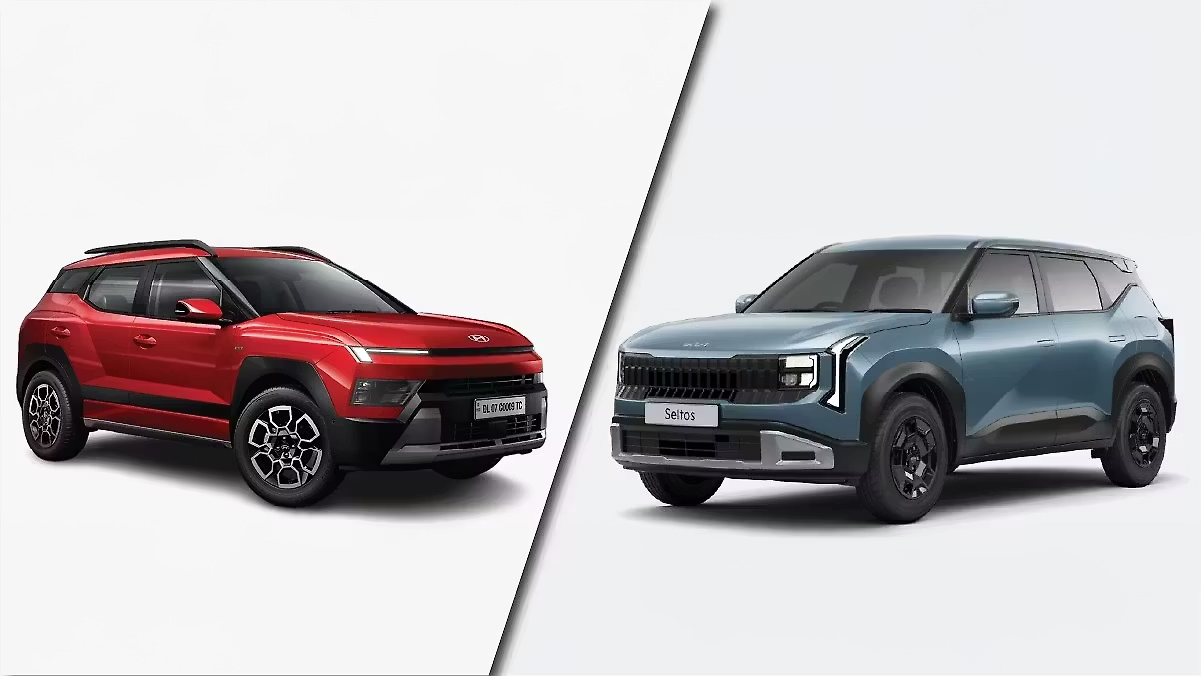
The Hyundai Bayon HX3 vs Kia Seltos HTE comparison is one that every Rs 10–12 lakh budget buyer in India should work through before walking into a showroom. The Hyundai Bayon launched in October 2026 at a starting price of Rs 9.99 lakh, with the HX3 trim priced at Rs 10.90 lakh (ex-showroom). The Kia Seltos HTE, the base entry point to India’s best-selling compact SUV, sits at Rs 10.99 lakh (ex-showroom).
The Hyundai Bayon HX3 vs Kia Seltos HTE price gap is Rs 9,000 — narrow enough that most buyers will end up choosing on features, safety, and space rather than price alone. Both cars share the same hardware: a 1.5-litre naturally aspirated petrol engine producing 113 bhp power output and 144 Nm torque, mated to a six-speed manual gearbox. Under the skin, the two cars make very different bets about what an Indian base-variant buyer actually needs.
How This Comparison Is Structured
This article works through specifications, safety, features, mileage, space, and the value-per-rupee question in that order. Each section reaches a verdict. Data comes from Autocar India’s variant analysis, V3Cars’ variant explainer, and Rushlane’s confirmed launch coverage. Prices are ex-showroom Delhi at October 2026 launch. Buyers should verify current prices at the nearest dealership before deciding.
Hyundai Bayon HX3 vs Kia Seltos HTE: Full Specification Face-Off
The Hyundai Bayon HX3 vs Kia Seltos HTE specifications tell two different stories about how each OEM interprets a compact SUV. On the powertrain, the match is exact — same engine displacement, same power, same torque, same gearbox. On dimensions, the Seltos is the larger car. At 4,460 mm long with a 2,690 mm wheelbase, it sits noticeably ahead of the Bayon at 4,245 mm long and a 2,600 mm wheelbase. The Hyundai Bayon vs Kia Seltos size comparison produces a 215 mm difference in length and a 90 mm difference in wheelbase — figures that translate directly into rear legroom advantage for the Seltos.
The Bayon reclaims ground in the boot. Its 505-litre boot space leads the Seltos HTE’s 447-litre boot space by 58 litres — an advantage of roughly one carry-on bag. For a buyer who prioritises luggage and cargo capacity over rear passenger space, that number shifts the calculation.
| Parameter | Hyundai Bayon HX3 | Kia Seltos HTE |
|---|---|---|
| Ex-showroom price | Rs 10.90 lakh | Rs 10.99 lakh |
| Engine | 1.5L NA Petrol | 1.5L NA Petrol |
| Power | 113 bhp (115 PS) | 113 bhp (115 PS) |
| Torque | 144 Nm | 144 Nm |
| Gearbox | 6-speed MT | 6-speed MT |
| Length | 4,245 mm | 4,460 mm |
| Wheelbase | 2,600 mm | 2,690 mm |
| Width | 1,810 mm | 1,830 mm |
| Height | 1,605 mm | 1,635 mm |
| Ground clearance | 205 mm | Not confirmed |
| Boot space | 505 litres | 447 litres |
| Platform | Hyundai K1-derived | K3 platform |
| Airbags | 6 | 6 |
| ESC | Yes | Yes |
| TPMS | Yes | Yes (with display) |
| Touchscreen | 10.25-inch | 10.25-inch |
| Wireless Android Auto | Yes | Yes |
| Wireless Apple CarPlay | Yes | Yes |
| Push-button start | Yes | No |
| Cruise control | No (from HX5) | Yes |
| 4-wheel disc brakes | No (front disc, rear drum) | Yes |
| ARAI mileage | 17.2 kmpl (reported) | 16.5 kmpl (ARAI certified) |
All prices ex-showroom Delhi. Verify with dealer before purchase.
According to Autocar India’s variant-by-variant Bayon breakdown, the HX3 trim represents the first point in the Bayon lineup where the infotainment screen and keyless entry arrive as standard — making it the realistic entry point for most buyers. The Seltos carries the K3 platform — Kia’s newer global architecture that enables the larger body and, more critically, four-wheel disc brakes at base trim. The Bayon’s front disc, rear drum setup is a gap that safety-conscious buyers will notice.
Safety Equipment: Where Hyundai Bayon HX3 vs Kia Seltos HTE Diverge Most
On the Hyundai Bayon HX3 vs Seltos HTE features comparison at the safety level, the picture is more nuanced than a spec table shows. Both cars carry six airbags as standard — front, side, and curtain — alongside Electronic Stability Control (ESC), Hill-start Assist Control, and a tyre pressure monitoring system (TPMS). The Bayon HX3 also includes a rollover sensor standard across the range. The Seltos HTE carries TPMS with a display readout, which is more informative than a warning light alone.
Where the Seltos HTE pulls ahead is brake architecture. Four-wheel disc brakes at base trim give the Seltos shorter, more consistent stopping performance in emergency manoeuvres. The Bayon HX3 uses front disc and rear drum — a cost-reduction choice common at this price point, but a real gap relative to an all-disc setup.
The Bharat NCAP safety rating position between the two cars is unconfirmed at publication. The Kia Seltos carries a previous-generation 5-star score, but the 2026 model’s rating had not been published at launch. The Hyundai Bayon has not yet been submitted for Bharat NCAP testing as of October 2026. Buyers who weight a crash test score heavily should monitor both OEMs’ announcements before deciding.
Neither car offers Level 2 ADAS at base trim. Autonomous emergency braking, lane keep assist, and blind spot monitoring appear only in upper-trim ADAS Pack variants of both models.
Which Base Variant Is Safer for Indian Road Conditions?
For Indian highway and city driving — pothole loads, mixed pedestrian and vehicle lanes, frequent emergency stops — Electronic Stability Control (ESC) and six airbags represent the most important safety floor. Both cars meet this floor equally. The Seltos HTE edges ahead on four-wheel disc brakes, which matter most in high-speed braking situations. The Bayon HX3’s rollover sensor is a useful addition at a price point where many competitors omit it. On balance, the Seltos HTE holds a narrow safety advantage at base trim, primarily because of its all-disc brake setup.
Features Comparison: Infotainment, Connectivity, and Comfort at Base Trim
The Hyundai Bayon vs Kia Seltos base variant comparison on features produces a split result — the Bayon HX3 wins on convenience tech, while the Seltos HTE leads on driver controls.
Both cars carry the same 10.25-inch touchscreen infotainment unit at base trim, with wireless Android Auto and wireless Apple CarPlay as standard. This is a meaningful feature parity — most base-trim compact SUVs in this segment still run wired connectivity. The Bayon HX3 adds a 12-inch instrument display that the Seltos HTE does not match at this level; the Seltos HTE runs a 4.2-inch digital instrument display. The Bayon’s larger digital cluster is a visual advantage in daily driving.
On starting and driving convenience, the gap is notable. The Bayon HX3 carries smart key and push-button start as standard — the Seltos HTE does not. A buyer stepping out of any mid-range hatchback into the Bayon HX3 gets keyless start without paying for a higher trim. The Seltos HTE withholds this until the HTK variant.
Cruise control goes the other way. The Seltos HTE includes cruise control with steering-mounted controls as standard. The Bayon HX3 does not offer cruise control until the HX5 trim. For highway buyers — particularly those covering expressway distances between cities — this is a daily comfort feature worth noting. Climate control is manual on both cars at base trim; automatic climate control requires stepping up on both ladders.
Connected Car and App Features: Does Either Base Variant Offer Them?
Neither the Bayon HX3 nor the Seltos HTE carries connected car features at base trim. Hyundai’s BlueLink with over 70 connected car functions appears at higher Bayon trims. Kia’s Connect app features are similarly withheld from the HTE level. For buyers who want connected car technology features like remote start, live vehicle tracking, geofencing, and over-the-air updates, both cars require a trim step-up — plan for HX5 on the Bayon or HTK on the Seltos to access these features.
Mileage and Running Costs: Kia Seltos HTE vs Hyundai Bayon HX3
On Kia Seltos HTE vs Hyundai Bayon HX3 mileage, the numbers favour the Bayon marginally. The Hyundai Bayon’s 1.5-litre naturally aspirated petrol engine with the six-speed manual gearbox returns a reported 17.2 kmpl — this figure has been reported by V3Cars and is yet to receive ARAI official certification confirmation as of this writing; treat it as a manufacturer-sourced claim. The Kia Seltos HTE with the same 1.5-litre NA petrol 6MT returns an ARAI-certified 16.5 kmpl — this figure is confirmed by Rushlane from the official Kia India mileage release.
For Indian conditions — city traffic, mixed national highway driving, periodic idle — real-world mileage typically runs 15–20% below ARAI figures. That puts the Bayon at approximately 13.8–14.6 kmpl real-world and the Seltos HTE at approximately 13.2–14 kmpl in mixed use.
| Parameter | Hyundai Bayon HX3 | Kia Seltos HTE |
|---|---|---|
| Claimed mileage (6MT) | 17.2 kmpl (reported) | 16.5 kmpl (ARAI certified) |
| Real-world estimate | ~13.8–14.6 kmpl | ~13.2–14 kmpl |
| Cost per km (petrol at Rs 95/litre) | ~Rs 6.50–6.90 | ~Rs 6.80–7.20 |
| Monthly fuel cost at 1,500 km | Rs 9,750–10,350 | Rs 10,200–10,800 |
Petrol price reference: Delhi, approximately Rs 94–96/litre, October 2026. Verify current pump price before calculating.
The monthly running cost difference is approximately Rs 450–650 in the Bayon’s favour, assuming the mileage difference holds in real-world conditions. Over a 3-year ownership period, that aggregates to Rs 16,000–23,000 in fuel savings — not insignificant at this price point, though it depends on actual driving patterns.
Space, Practicality, and Rear Seat Comfort: The Everyday Ownership Test
The Hyundai Bayon vs Kia Seltos size comparison in daily use shows up most clearly in the rear cabin. The Seltos HTE’s 90 mm wheelbase advantage over the Bayon translates into noticeably more rear legroom — a gap that adult passengers feel immediately on trips over 30 minutes. The Seltos is also wider by 20 mm, contributing to shoulder room at the rear. Families choosing between these two cars on practicality grounds should prioritise the Seltos for rear passenger comfort.
Boot space runs the other way. The Bayon’s 505-litre boot space leads the Seltos HTE’s 447-litre boot space by 58 litres — roughly the difference between fitting three large suitcases and fitting two plus a backpack. Both cars offer a 60:40 split-fold rear seat, so cargo capacity scales similarly when rear seats go down. For a family whose priority is weekend luggage over daily rear-seat legroom, the Bayon’s boot is a genuine draw.
The Bayon also carries a 205 mm ground clearance — a useful number for India’s variable road surfaces. The Seltos HTE’s ground clearance is not officially confirmed for the base trim at the time of writing; V3Cars confirms it at higher trims, so base-trim buyers should verify with the dealer.
Is Kia Seltos Worth Rs 35,000 More Than Hyundai Bayon at Base Trim?
The Rs 9,000 ex-showroom gap narrows the “Is Kia Seltos worth ₹35,000 more than Hyundai Bayon?” argument significantly. The often-cited Rs 35,000 premium appears to be based on earlier pre-launch estimates; the actual ex-showroom delta at launch is Rs 9,000 — a difference that becomes inconsequential once both prices receive the 10–15% on-road addition of road tax, registration, and insurance.
What the Seltos HTE’s Rs 10.99 lakh buys over the Bayon HX3’s Rs 10.90 lakh: four-wheel disc brakes, a slightly larger body with more rear legroom, cruise control, the K3 platform engineering pedigree, and the Seltos brand’s established resale track record in India. What the Bayon HX3 returns for its lower price: push-button start, a larger 12-inch digital instrument display, higher reported mileage, 58 extra litres of boot space, and a more recent-generation exterior design.
The Bharat NCAP safety rating question may resolve this comparison more definitively once Hyundai submits the Bayon for testing. If the Bayon matches the Seltos’s five-star expectation, the safety argument for the Seltos at base trim narrows further. Until then, the Seltos HTE’s all-disc brake setup and K3 platform credentials give it a small but real structural argument for the Rs 9,000 premium — which, on-road in most states, effectively disappears into rounding.
The Hyundai Bayon vs Kia Seltos which is better question has no single answer. Both cars are worth the money. The decision comes down to what the buyer prioritises — and the next section maps that directly.
Tips for Buyers Choosing Between Hyundai Bayon HX3 and Kia Seltos HTE
Insist on the base trim at the showroom, not the top variant on display. Dealers almost always park the fully loaded HX8 or GTX on the showroom floor. A buyer comparing base variants needs to see the HX3 and HTE specifically. If the dealer doesn’t have them in stock, ask for the base-trim test drive car, not the top-spec car’s experience mapped back to a base price.
Check the disc brake configuration before signing. Four-wheel disc brakes on the Seltos HTE versus front disc, rear drum on the Bayon HX3 is a real-world safety difference. In panic braking at highway speeds, all-disc setups consistently outperform mixed configurations. Buyers who cover significant national highway distances should factor this in before deciding.
Calculate on-road cost, not ex-showroom, for a real comparison. At Rs 10.90 lakh and Rs 10.99 lakh ex-showroom, both cars land within Rs 10,000–15,000 of each other on-road in most states. The meaningful ownership comparison is the 3-year total of EMI, insurance, service, and fuel — not the sticker price alone.
Verify service centre proximity for your specific city. Hyundai’s service network in India spans over 1,300 authorised service centres. Kia’s network is smaller at approximately 800 authorised outlets. For base-trim buyers, the nearest authorised workshop matters more than the badge. A Seltos HTE 40 km from the nearest Kia workshop is a harder ownership proposition than a Bayon HX3 five minutes away.
Ask the dealer about the first two free services and consumable costs. Both Hyundai and Kia offer manufacturer-included service packages, but the scope differs. Confirm the dealer’s pricing for oil type, filter replacement, and labour rates at the 10,000 km service interval before committing to either car.
FAQ: People Also Ask About Hyundai Bayon HX3 vs Kia Seltos HTE
Q1. What is the price difference between Hyundai Bayon HX3 and Kia Seltos HTE?
The Hyundai Bayon HX3 vs Kia Seltos HTE ex-showroom prices at October 2026 launch are Rs 10.90 lakh (Bayon HX3) and Rs 10.99 lakh (Seltos HTE) in Delhi. The ex-showroom gap is Rs 9,000. On-road, after road tax, registration, insurance, and accessories, both cars will cost approximately Rs 12.5–13.5 lakh depending on the state of registration. Prices vary by state — Delhi, Maharashtra, and Karnataka have different road tax rates. Always compare ex-showroom figures directly and add your state’s on-road components separately.
Q2. Which car has better safety features — Hyundai Bayon HX3 or Kia Seltos HTE?
Both carry six airbags, Electronic Stability Control (ESC), Hill-start Assist Control, and TPMS at base trim. The Seltos HTE adds four-wheel disc brakes — the Bayon HX3 uses front disc, rear drum. The Seltos also does not confirm a rollover sensor at HTE trim; the Bayon includes one as standard. The Bharat NCAP safety rating for the 2026 Bayon has not been published; the Seltos has an established crash test pedigree from the previous generation. On the brake architecture question alone, the Seltos HTE holds a narrow safety edge.
Q3. Does Hyundai Bayon HX3 get a touchscreen at base trim?
Yes. The Bayon HX3 carries a 10.25-inch touchscreen infotainment system as standard, with wireless Android Auto and wireless Apple CarPlay both included. The Bayon HX2 (one step below) does not have the touchscreen. The Seltos HTE also carries a 10.25-inch touchscreen with wireless Android Auto and wireless Apple CarPlay. On infotainment at base trim, both cars are equivalent — the Bayon adds a larger 12-inch digital instrument cluster, while the Seltos offers a 4.2-inch unit.
Q4. Which has more boot space — Hyundai Bayon or Kia Seltos?
The Hyundai Bayon carries a 505-litre boot space, while the Kia Seltos HTE offers 447-litre boot space. The Bayon leads by 58 litres — roughly enough for one additional checked luggage bag on a family trip. Both cars fold the rear seats in a 60:40 split, extending cargo capacity when needed. For frequent travellers, weekend-trip families, or anyone who prioritises cargo over rear legroom, the Bayon HX3’s boot is a meaningful advantage.
Q5. Is Hyundai Bayon HX3 vs Kia Seltos HTE a fair comparison at the same price point?
Yes — the Hyundai Bayon HX3 vs Kia Seltos HTE comparison is as fair as base-variant comparisons get. Both cars price within Rs 9,000 of each other ex-showroom, use the same engine and gearbox, and sit in the same compact SUV segment targeting the same first-time SUV buyer. The value-per-rupee framework depends on the buyer’s priority: the Bayon HX3 gives more boot space, push-button start, a larger instrument display, and higher reported mileage; the Seltos HTE gives more rear legroom, all-disc brakes, cruise control, and K3 platform engineering. Neither car is a wrong choice at this price point — the question is which set of trade-offs fits the buyer’s daily use.
One Car Wins on Boot and Convenience, One on Brakes and Legroom — Here Is the Honest Verdict
The Hyundai Bayon HX3 vs Kia Seltos HTE comparison does not produce a runaway winner — it produces two well-defined buyer profiles.
A buyer who covers city and expressway distances daily, regularly carries adult rear passengers, and plans to keep the car for 4–5 years will find the Seltos HTE’s longer wheelbase, all-disc brakes, and cruise control more aligned with daily needs. The K3 platform’s structural advantage may also deliver better long-term NVH refinement — confirm this on a test drive, not a spec sheet.
A buyer who prioritises boot capacity for frequent travel, values push-button start at base trim, and drives primarily with two occupants will find the HX3 the smarter allocation of Rs 10.90 lakh.
The Hyundai Bayon HX3 vs Kia Seltos HTE price gap on-road is too small to be a deciding factor. The real decision sits between four-wheel disc brakes versus a 58-litre boot advantage, rear legroom versus a 12-inch instrument display, and cruise control versus push-button start.
Pick the feature set that matches how the car will actually be used — not the one that looks best on a spec sheet.
When Hyundai submits the Bayon for Bharat NCAP testing, the safety comparison will gain a common benchmark. Until then, the Seltos HTE’s established crash test track record is the conservative choice for buyers who weight safety certification heavily. Verify current ex-showroom prices at the nearest dealership before deciding.